
The Russian Nuclear Program
How the former Soviet state continues to charge forward atomically

Welcome back to another edition of the National Nuclear Outlook, this week we will be covering the Russian Federation’s nuclear program. However, due to the short history of modern day Russia we will be focusing in on after the fall of the USSR. In a later entry of the National Nuclear Outlook we will cover the vast history that nuclear power had in the Soviet Union pre and post-collapse. Due to the inter-connectivity of Russia and Rosatom, this week will be focused on domestic plans while our next Company in Focus on Rosatom will focus on foreign influence.
A few weeks ago we went in depth with Rosatom’s VVER-TOI, the new flagship reactor model produced in Russia. The interesting thing about the Russian nuclear program is that is powered by a semi-private company, Rosatom, which has many for foreign interests. Alongside the deployment of the VVER-TOI, many VVER-1200 and even earlier VVER models are being set up in Central and Eastern European countries. The Russian home front has been focused on accelerating the deployment of the VVER-TOI, while re-establishing and maintaining foreign nuclear deals.
Russia itself has thirty-four operable reactors, with six under construction totaling up to ~31500 MWe. Another twenty three are planned totaling up to an additional ~21600 MWe. Out of the current planned and in construction reactors twelve are VVER-TOIs, nine are older VVER models, four are RITM-200 SMRs, one BREST-OD-300, and three BN-1200s. Our focus this week will be on these less popular Russian reactors.
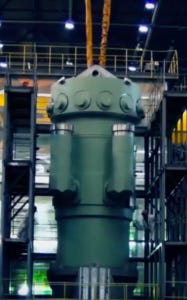
The RITM-200 model (image 1) of reactors are one of Rosatom’s take on modern small modular reactor (SMR) developed by the special engineering division, OKBM Afrikantov. The RITM-200 is a PWR designed to output 55 MWe and has two designs, the N and S model. The RITM-200N is the land-based design, with a planned lifespan of 60 years and fuel-cycle of 6. The S model is made for floating nuclear power plants (FNPPs) and built to have a longer lifespan.

Alongside the RITM-200S, there is also the KLT-40S designed by OKBM Afrikantov which is the preliminary FNPP reactor currently being used in the Akademik Lomonosov (image 2). OKBM Afrikantov also leads the design for the BN series of reactors, with the latest model the BN-1200 recently starting construction. The BN-1200 is a modern Gen III+/IV fast breeder reactor with sodium as a coolant, and one of the most historied reactor models in CiS countries. The Russian FBR designs are so interesting if fact, that a future Reactor in Focus will be diving into the BN-1200.
The Chernobyl reactor, a RMBK, still has seven siblings running in modern day Russia. These RMBK-1000 have been heavily modified following the infamous meltdown and are no longer in production. The graphite cooled reactors were very unique, featuring a positive coefficient and a pair coolant flow regime. All the remaining RMBKs in Russia were all built in 1990 or earlier, with no future plans to reiniate the RMBK program.
Lastly, the BREST-OD-300 being developed in Seversk is an experimental design, trying to close the nuclear fuel cycle using lead as coolant. The present goal of the reactor is to demonstrate that a completely closed fuel cycle is possible in a breeder reactor but there are many skeptics claiming that the BREST-OD-300 operation temperature will cause the core structure to corrode. The BREST-OD-300 is being designed from nearly first principles, with its biggest marketing factor being moving away from traditional nuclear fuel rods.
In the end, the Russian nuclear power program shows us that innovation is always possible and that we here in the United States can rally together our brilliant minds and venture into the next generation of nuclear reactors, designing outlandish and unique features to truly show that The Future is Nuclear.
Further Reading:
RITM Under Production - WNN 2025
World’s First Floating Nuclear Power Plant to Grid - WSNIR 2019