
The Canadian Nuclear Program
How do our friends up north harness nuclear potential?

This week’s article marks the first post in a new bimonthly series, National Nuclear Outlook, which will be focused on the how different nuclear programs were founded and which organization(s) regulate nuclear power in different countries. I hope you all enjoy!
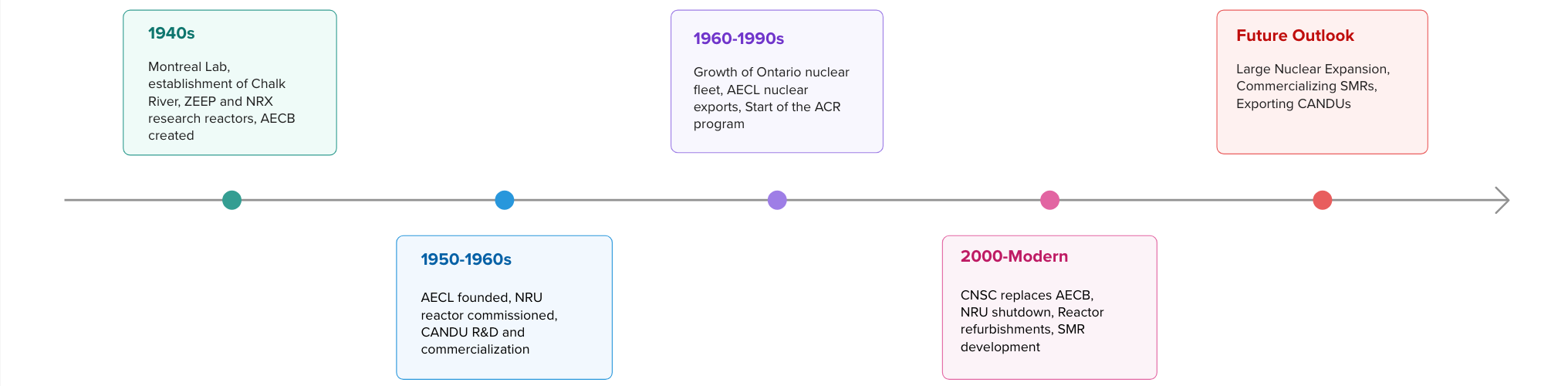
1940s
Following the end of World War Two, the Canadian government built the Chalk River Nuclear Laboratory in Ontario. The Zero Energy Experimental Pile (ZEEP) was the first reactor to operate outside of the US; going critical for the first time in late 1945. Going critical means to achieve a stable, self-sustaining fission chain reaction. The ZEEP was a prototype reactor designed to test the theory behind the National Research Experimental Reactor’s (NRX) design before work started on constructing the NRX. While the ZEEP was built and designed by a joint UK-Canada team of scientist the United States provided ample support by giving key information about heavy water reactors.
Following the success of the ZEEP, Canada founded their first regulatory committee for nuclear technologies, the Canadian Atomic Energy Control Board (AECB) in 1946. Then in 1947 the NRX finished construction and went critical for the first time operating at a max power of 20MW. Below, in image one the NRX and ZEEP buildings are shown.

1950s-1960s
In 1952 the Atomic Energy of Canada Limited (AECL) was founded as a Canadian Crown Company to research and develop peaceful uses of nuclear energy. The AECL would be the company to develop and commercialize the CANDU (Canadian Deuterium Uranium) reactor for civilian use. Five years after the founding of the AECL, the National Research Universal Reactor (NRU) went critical for the first time. The NRU was the direct successor of the NRX and was used to generate radionuclides for medical treatment and to test fuels for the first CANDU reactors. It had a max operating power of 135MW. Picture below in image 2 is the layout of the NRU.

The success of the NRU led to the development of the Nuclear Power Demonstration Prototype Reactor (NPD) which went critical in 1962. The NPD was a test reactor and the prototype for a commercial CANDU reactor. The reactor supplied power to the wider Ontario area and served as the training ground for many a reactor operator until 1987 when it was officially shutdown.
Seeing the success of the NPD the AECL furthered their research and development into CANDU reactors leading to the Whiteshell Reactor 1 (WR-1) and Douglas Point Reactor going critical in 1965 and 1966 respectively.
1960s-1990s
With the monumental success of the various CANDU prototype reactors the first commercial CANDU reactor was was launched in 1971 with the building of the Pickering-A CANDU reactor. Operated by Ontario Power Generation (OPG), Pickering-A was the first of 8 CANDU reactors, some still in use today, at the Pickering Nuclear Generating Station (image 3).
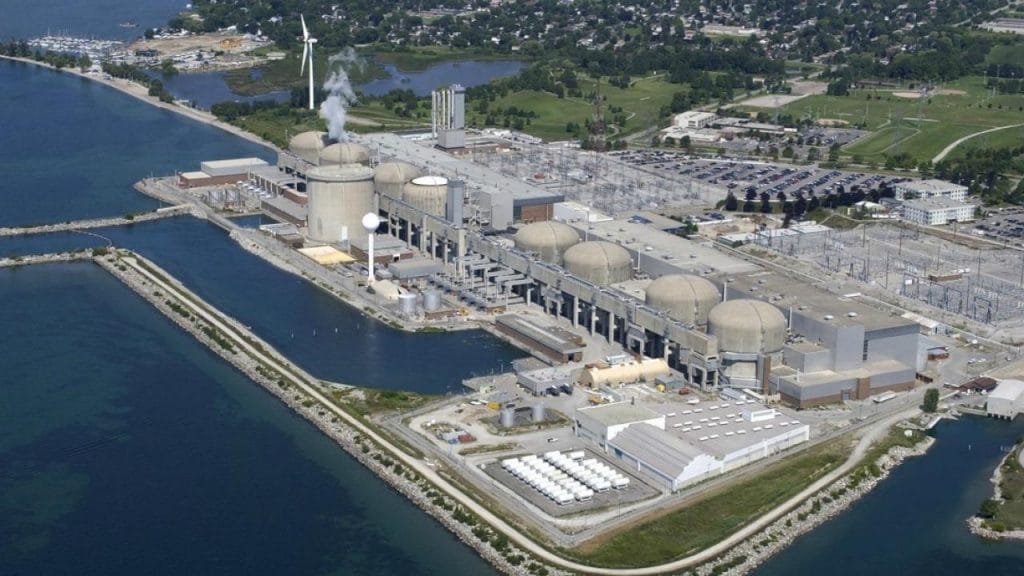
Following the mobilization of the a national CANDU fleet in Canada, the AECL began exporting CANDU reactor technologies to foreign entities, with initial transfers being to India and Argentina in the mid 1970s. With the success of domestic, commercial CANDU reactors the research reactors of the 1960s starting shutting down in the early 1980s, only leaving the NRU running past the 1990s.
2000-Modern
In May of 2000, the AECB was disbanded and replaced by the Canadian Nuclear Safety Commission (CNSC). The CNSC was created to regulate a wider berth of nuclear issues, ranging from reactor development to environmental safety. With the founding of the CNSC came new regulations that led to refurbishment of many Canadian reactors, improving both safety and power output.
In 2018 the last of the AECL CANDU prototype reactors was shutdown; the NRU was the longest active running nuclear reactor at time of shutdown. Prior to the shutdown of the NRU the AECL sold all holdings and rights to the CANDU reactors to CANDU Inc. in 2011.
Future Outlook
With the increasing power demands of 21st century and beyond life comes a renewed need for advanced power generating reactors. Canada is tackling these increasing energy demands by creating new nuclear plants like the Darlington New Nuclear Project which just started construction this year, 2025. The Darlington New Nuclear Project will have a GE Vernova-Hitachi BWX300 SMR* as its primary reactor.
Canada has also commissioned AtkinsRéalis to develop a 1000MW called the CANDU MONARK. OPG has also started collaborating with X-Energy on the Xe-100 SMR, looking to deploy them into the OPG nuclear fleet.
The future of nuclear energy is bright, not just in Canada but in the entire world, but as this new nuclear wave washes across the globe we must remember that only through constant development and research, like Canada’s nuclear history has shown us, can we truly realize that The Future is Nuclear.
*The GE Vernova-Hitachi BWX300 SMR will be the topic of our next Reactor in Focus and GE Vernova will the the first company covered in a new series Company Spotlight which will be similar to covering the history of the AECL in today’s article.
Though I always do recommend to dive deeper into my article topics by looking into the further reading articles and papers, this week I particularly recommend reading the following papers if you are interested into the inner workings of nuclear reactors, as knowing the exact procedure and design of modern reactors extremely rare.
Further Reading:
Canadian Nuclear Society Bulletin - CNS 1995
Operation of the WR-1 Organic Cooled Research Reactor - Tegart 1970
A General Description of the NRX Reactor - Larson 1961
The NRU Reactor - Boyd 1958
Really love the article this week!!